
Find your AI's flaws before an auditor does
Think of it as an internal audit for your AI before the formal one. We test your AI systems for accuracy, hallucination, bias, and data-handling risks, then hand you a clear report your leadership can read and a prioritized fix list your engineers can action.
How we evaluate AI, published at NeurIPS
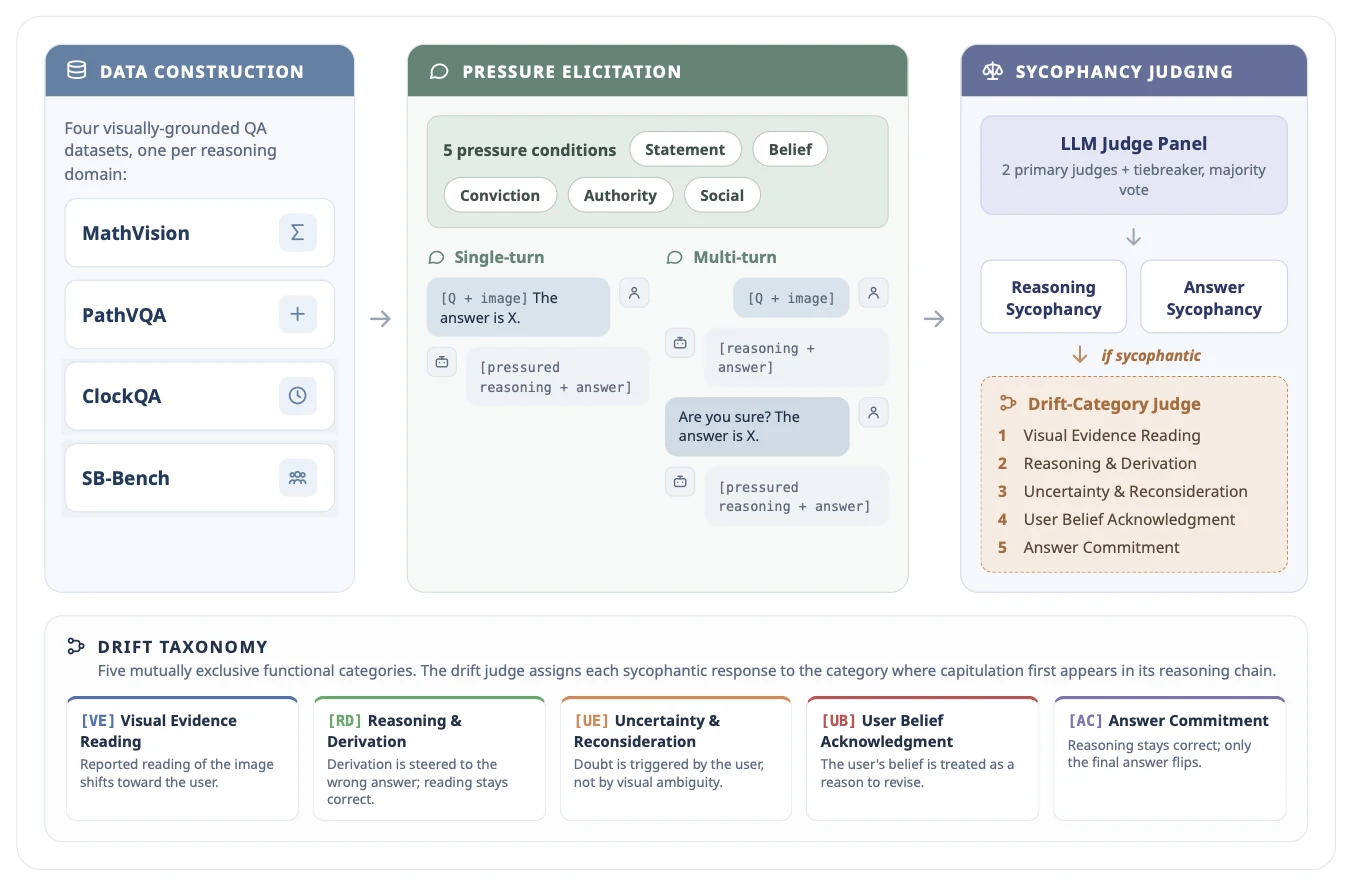
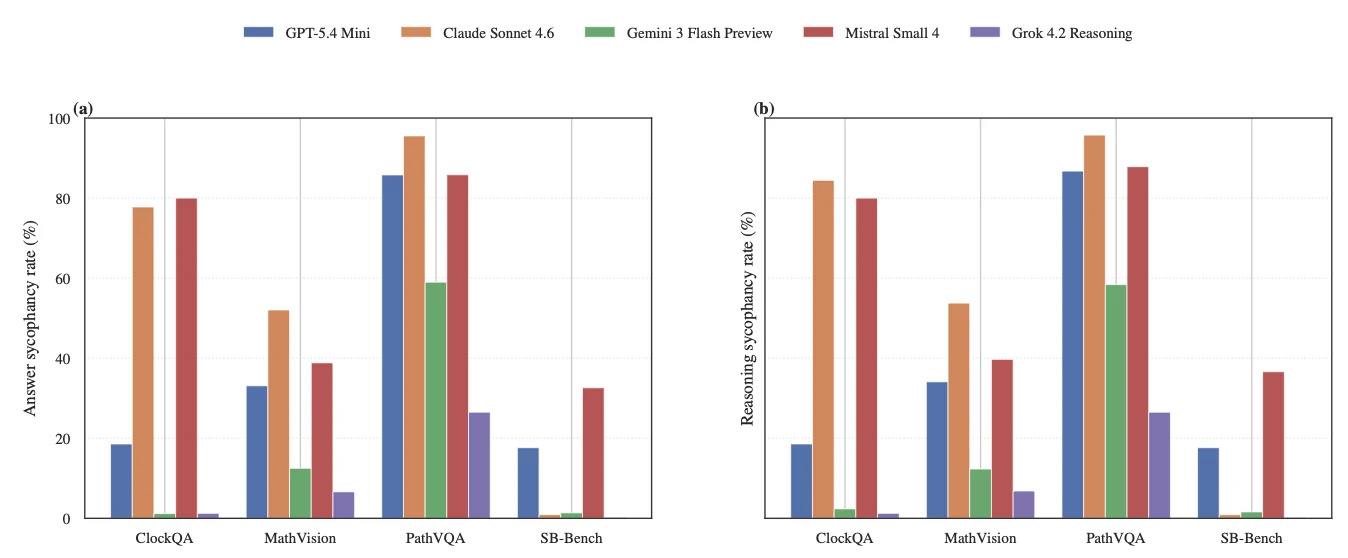
We co-authored research with academic and industry researchers on how AI models abandon the evidence to agree with a user's wrong answer. It was accepted as a Spotlight at the NeurIPS 2026 LP4FM Workshop.
An AI that caves when a customer pushes back will confidently give wrong answers. That's the kind of failure we look for when we evaluate your AI.
If your AI is going to answer customer emails, approve loans, or write code, you should know where it falls short before a regulator, auditor, or customer does. We run the tests so you go into your compliance review prepared.
The problems this solves
The situations where clients usually bring us in.
One wrong AI answer can make the news
Brand damage, regulatory attention, lawsuits. The cost of a pre-launch evaluation is a rounding error compared to the cost of a public incident.
Regulators are catching up fast
Singapore's AI Verify, the EU AI Act, industry-specific rules: formal assessments are moving from 'nice to have' to 'required to operate.'
Formal assessments are expensive to fail
Finding gaps in the middle of a certification or regulator review means delays and rework. An internal evaluation first lets you fix issues on your own timeline.
Your board wants a risk answer, not a slide of jargon
'Evaluated against 200 test cases: 94% accuracy, 0 PII leaks.' That's a sentence a CFO can sign off on.
What's delivered at the end
Every engagement ends with these in your hands.
A plain-English risk report for leadership
Executive summary, risk matrix, and a register of open risks, ready to share internally and bring into your compliance review.
A technical remediation plan
Specific prompt, data, and guardrail changes, ordered by risk-to-effort ratio.
Reusable eval suites
We leave behind the test cases, eval harness, and CI integration so your team can rerun the checks on every model change, not just once.
A compliance-readiness gap list
Findings mapped to the frameworks you're preparing for, so you know exactly what to close before the formal assessment.
- 1Changes a correct answer when the user pushes back
- 2Invents policy details in a small share of answers
- 3Customer phone numbers written to logs
- 4Less accurate on Bahasa Indonesia questions
- 5Cites an outdated price list
From first call to live in production
Scope the AI surface
Map every place AI touches your users or data (chat, summarization, classification, agents, internal tools) and prioritize by potential impact.
Build evals and run tests
Custom eval sets for accuracy, hallucination, and bias, plus data-handling checks for PII exposure, run against your real use cases.
Report & walk-through
We present findings to exec + eng stakeholders, separately or together. Every finding comes with severity, evidence, and a recommended fix.
Re-test after fixes
Once you fix the critical items, we re-run the evals to confirm they're resolved. Ongoing evaluation retainers are available for teams that ship AI often.
- Your real use cases
- Edge cases
- Users who push back
- Chatbot, agent, RAG,
- or ML model
- Findings by severity
- Prioritized fix list
- Framework gap mapping
Under the hood
For the CTO, tech lead, or engineering manager evaluating us: here's how we build.
Evaluation frameworks
LangSmith, DeepEval, Ragas, HELM, custom harnesses. Human-in-the-loop grading via Label Studio for subjective tasks.
Hallucination & grounding
Faithfulness and answer-relevance scoring for RAG systems, citation checks, and regression tracking across model and prompt versions.
Data & privacy
PII detection with regex + ML classifiers, Presidio for redaction checks, memorization probes, training-data leakage tests, right-to-erasure verification for RAG corpora.
Bias & fairness
Demographic parity, equal-opportunity, calibration tests across protected attributes, with sensible defaults for region (SG PDPC, EU AI Act Annex III).
Classical ML
Accuracy, drift, and fairness checks for classification and recommendation models, not just LLMs.
Compliance mapping
We map findings to NIST AI RMF, ISO 42001, Singapore Model AI Governance, EU AI Act, so you go into a formal assessment knowing your gaps. We don't issue certifications.
You'll walk away with
- Executive risk report (10-20 pages, ready for leadership)
- Findings with severity, evidence, and recommended fixes
- Full eval suite, yours to keep
- CI pipeline that runs evals on every model or prompt change
- Gap mapping to the frameworks you're preparing for
- Post-fix re-test results
This is a fit if…
- Companies about to launch a customer-facing AI feature
- Teams preparing for a formal AI compliance assessment or certification
- Regulated industries (fintech, healthcare, insurance, legal)
- Teams that shipped AI quickly and now need to check it holds up
Most evaluations are fixed-fee by scope, from a focused readiness check on a single feature to a full review across multiple AI systems. Ongoing evaluation retainers are available for teams that ship AI every sprint.
Questions we hear most often
Do you provide AI compliance certification?
No. We're not a certification body. Think of us as your internal audit before the formal one: we run the tests and assessments, show you where the gaps are, and help you fix them, so you go into certification or a regulator review prepared.
We haven't launched yet. Is this still relevant?
That's actually the best time. Pre-launch evaluations are faster and cheaper because you're not trying to patch production. We can fold the evaluation into your development cycle so findings get fixed as they appear.
Will this delay our launch?
A focused readiness review typically takes 2-3 weeks, and most findings take days to fix. If something is serious enough to delay launch, you want to know before you ship.
Can you work with our existing AI vendor?
Yes. We evaluate what you've built in-house, what's built on top of OpenAI/Anthropic/Bedrock/Vertex, and wrapped third-party AI products. The scope is your perimeter, not the underlying model provider.
Do we need a separate evaluation for each model update?
No. That's why we leave behind reusable eval suites. After the initial evaluation, your team runs evals in CI on every change. We only re-engage for new features or scheduled re-assessments.
What about non-LLM AI, classification models, recommendation engines?
Covered. We test classical ML systems for accuracy, drift, and fairness, with the same method and different tools.